

Brian Portilia and Dr. Syed Mehdi, Orthopedic Spine Surgeon
“This all began on a Saturday last fall,” recalled Brian Portilia, a Kenosha native and longtime owner and operator of Super Sports Footwear. “I did some work in my shop and then had my grandson over to eat pizza and watch football. But when I tried to get out of bed Sunday morning to go fishing with him, I fell flat on my face. I first thought I’d had a stroke, even though I could move my hands and speak. But I had no control over my right leg below the knee. I couldn’t stand up. That really scared me. I was then stuck in a wheelchair to get around. I had no idea what was going on. I didn’t know if this was permanent or temporary, whether it would be a quick fix or a long ordeal.”

Brian Portilia
Diagnosing the problem
A few days later, Portilia sought medical advice. He expressed his fears to Dr. Syed Mehdi, an orthopedic spine surgeon at Froedtert Pleasant Ridge Clinic. Based on a thorough examination and the results of an MRI, Dr. Mehdi concluded that Portilia’s pain was caused by what’s called spinal stenosis.
“Spinal stenosis is just a medical term for pinched nerves in the back,” Dr. Mehdi said. “It’s a very common problem that many people experience as they age. The typical symptoms are pain in the back and legs after standing for long periods of time, and numbness or tingling down the legs when walking longer distances.”
“Most patients that I see with this condition have had chronic pain that has gotten progressively worse for a long time,” Dr. Mehdi said. “But these symptoms can appear very rapidly and unexpectedly if there is a sudden pinching of the nerves. You go to bed feeling fine, and when you wake up, you can’t control your legs. It’s rare, but that’s what happened to Portilia.”
“Physical therapists I know have asked me if I had any indication beforehand that something was wrong with my back,” Portilia said. “I told them that I felt fine, had worked until five the day before, went to bed and then couldn’t walk the next morning. It was just crazy.”
Treatment options
“Physical therapy or injections are effective treatments for many patients with this condition,” Dr. Mehdi said, “especially those who are unable or afraid to undergo surgery. But based on how rapidly Portilia’s symptoms appeared, I wasn’t completely confident that those approaches would help him much. That left surgery as his best option.”
“It’s normal to have reservations about any surgery,” Portilia said, “but at that point I was more concerned that I’d never walk again. Deciding to have the operation was easy for me.”
“Also, many patients don’t want to be in the hospital for days, then at home in pain and unable to work or do what they want for an extended period of time,” Dr. Mehdi said, “but those surgeries are a thing of the past. The vast majority of my surgery patients are in the hospital for only a few hours, occasionally overnight when absolutely necessary. The incisions are small and the post-surgery pain is minimal. In fact, when we take the pressure off of their pinched nerves, their pain goes away very quickly, often instantly,” Dr. Mehdi said.
Dr. Mehdi performed surgery on Portilia the following week.

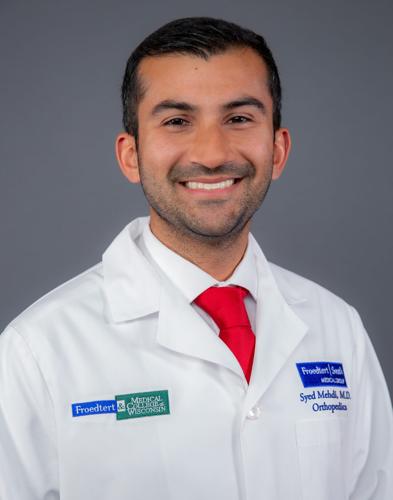
Dr. Syed Mehdi
A positive outcome
“It was a quick surgery and I went home the same day,” Portilia recalled. “There was a little minor pain from the incision but that was very manageable. Most importantly, the surgery worked! It eliminated the pain, and my recovery has been great. I could walk, work and do whatever I wanted almost immediately. I’m 100% happy with the outcome.”
“Dr. Mehdi is a good surgeon and a good guy,” Portilia said. “He explained everything very thoroughly to me. When I asked questions, he answered them in terms I could understand. I was especially happy that he was able to get me into surgery as quickly as he did. I’ve had wonderful results.”
“After my surgery, customers would come into the store and say, ‘Oh my goodness. You were in a wheelchair the last time I saw you, and you’re already walking?’” Portilia said. “I tell them that I had a good surgeon that helped me and here I am. My advice to anybody with this pain is this: Do not be afraid of the surgery. Get it done and put the pain behind you.”
“If this kind of back and leg pain is affecting someone’s quality of life,” Dr. Mehdi said, “it’s worth coming to see us to find out if we can make them feel better and get them back to working and doing what they like quickly without the long recovery.”
Spinal surgery by the numbers
According to the National Institutes of Health:
- Approximately 11% of people in the U.S. suffer from lumbar (lower back) spinal stenosis.
- 40% to 70% of people over age 60 show some evidence of spinal stenosis.
- Over three years, approximately one-third of spinal stenosis patients improve without surgery, 50% stay the same, and 10% to 20% worsen.
- At least 80% of patients who undergo surgery experience relief of their pain.
Visit froedtertsouth.com for more information.